Free
For getting started.
$0/ forever
Try the demoNo credit card required
- 5 deep assessments per month
- Unlimited summaries and key points
- All 10 CRAF dimensions
- Automatic source detection
- Limited Labs conversations
Syllogos is an AI app for assessing research papers. See methods, strengths and weaknesses, with evidence you can check.
Three real papers. No signup.
Understand the strengths.
Keep the limitations in view.
Strong experimental design.
Limited reporting of uncertainty.
Read, assess and organize your research in one app.
Capture a screen, upload a file, enter a DOI or paste text. Syllogos retrieves available publication details and full text.
Capture a screen, upload a file, enter a DOI or paste text. Syllogos retrieves available publication details and full text.
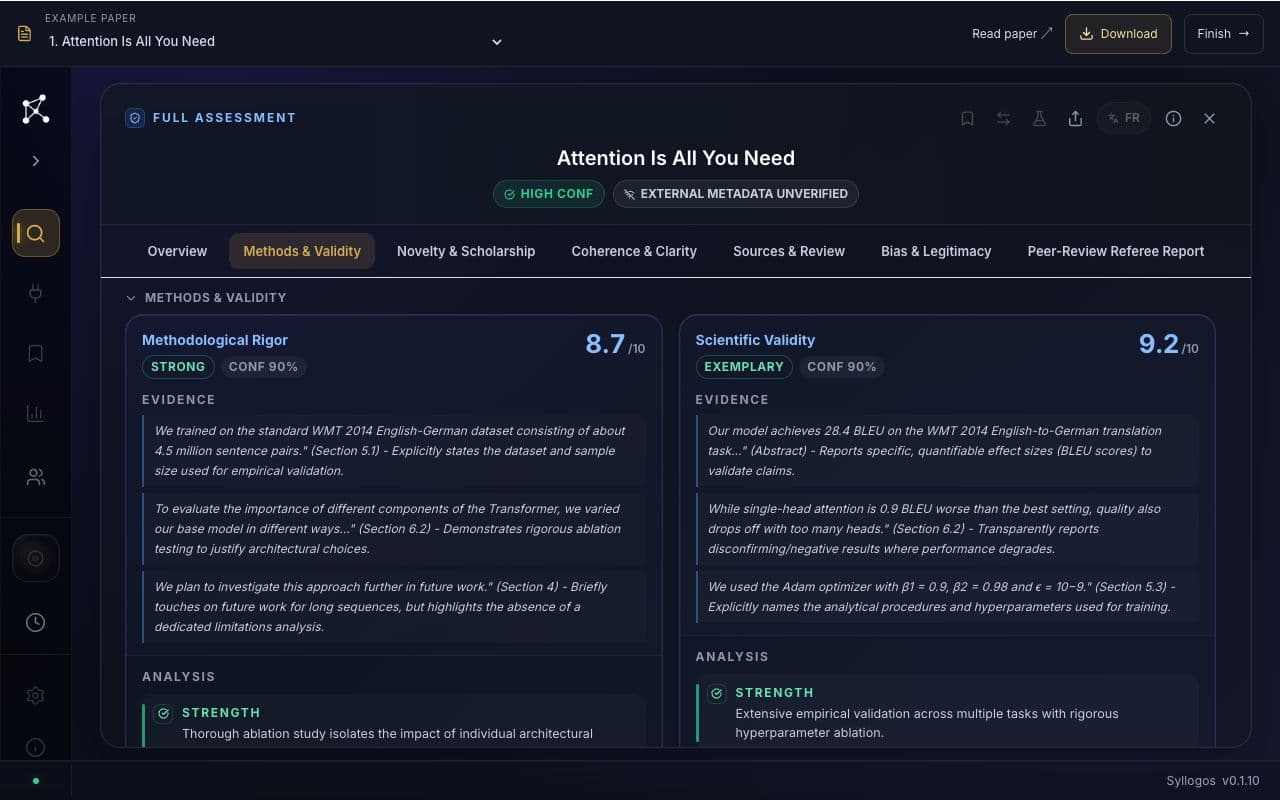
Assess a paper with CRAF 4.6. Review its methods, originality, sources and bias, with evidence explaining the findings.
Assess a paper with CRAF 4.6. Review its methods, originality, sources and bias, with evidence explaining the findings.
Open Syllogos over a paper, capture what you need and return to reading. Keyboard shortcuts keep it close.
Open Syllogos over a paper, capture what you need and return to reading. Keyboard shortcuts keep it close.
Discuss a paper through five research perspectives, from Positivist to Pragmatist. Ask questions and challenge the reasoning.
Discuss a paper through five research perspectives, from Positivist to Pragmatist. Ask questions and challenge the reasoning.
Save assessments alongside their sources. Revisit the evidence, compare papers or export a report.
Save assessments alongside their sources. Revisit the evidence, compare papers or export a report.
Explore disciplines, quality scores and recurring ideas across your saved assessments.
Explore disciplines, quality scores and recurring ideas across your saved assessments.
Explore how CRAF assesses research.
Attention Is All You Need · 2017
Were the methods rigorous?
Thorough ablation study isolates the impact of individual architectural components.
Lacks a dedicated limitations section discussing specific failure modes.
Add a substantive discussion of the model's limitations on extreme sequence lengths.
Does the evidence support the conclusions?
Extensive empirical validation across multiple tasks with rigorous hyperparameter ablation.
Does not report variance or confidence intervals across multiple random seeds.
Include standard deviations or statistical significance tests for the BLEU improvements.
What does this work add to its field?
Introduces a fundamentally new architecture dispensing entirely with recurrence.
None; the contribution is unequivocally field-redefining.
Not applicable for a field-redefining, foundational contribution.
Do the ideas and arguments hold together?
Mathematical formulation of attention perfectly aligns with goals of reducing sequential ops.
Connection between attention heads and linguistic structures is observational.
Provide formal theoretical proof of why specific heads capture syntactic dependencies.
Does it engage with relevant research?
Accurately synthesizes limitations of existing recurrent models to motivate the new design.
The literature review is relatively brief regarding linguistic motivations for attention.
Expand background to critically evaluate prior work on hierarchical attention models.
Are the sources dependable?
Cites foundational and state-of-the-art papers from top-tier venues to establish baselines.
Heavy reliance on arXiv preprints bypasses formal peer review at the time of citation.
Update citations to their formally published versions where available.
Is the research clearly explained?
Exceptionally clear technical descriptions make a complex novel architecture easy to implement.
Some figure captions are brief and rely heavily on the main text for context.
Expand figure captions to be fully self-contained explanations of the visual diagrams.
What peer scrutiny has it received?
Published in NeurIPS 2017, a universally recognized top-tier venue in machine learning.
Conference proceedings typically do not publish revision histories or reviewer notes.
Publish open peer review reports alongside the final manuscript.
Does it acknowledge bias and limitations?
Maintains an objective register and transparently reports negative results in ablations.
Lacks explicit conflict-of-interest or funding disclosure statements.
Add explicit funding and conflict-of-interest declarations to meet modern standards.
What assumptions and authority does it rely on?
Provides an exceptionally detailed author contribution statement assigning specific credit.
Does not explicitly discuss the broader societal implications of scalable language models.
Include a brief discussion on the potential downstream impacts of the technology.
Rubrics and calibration anchors set the scores. Checklists audit the evidence, rather than calculate scores. The overall score is weighted by discipline.
Explore six views of the app.
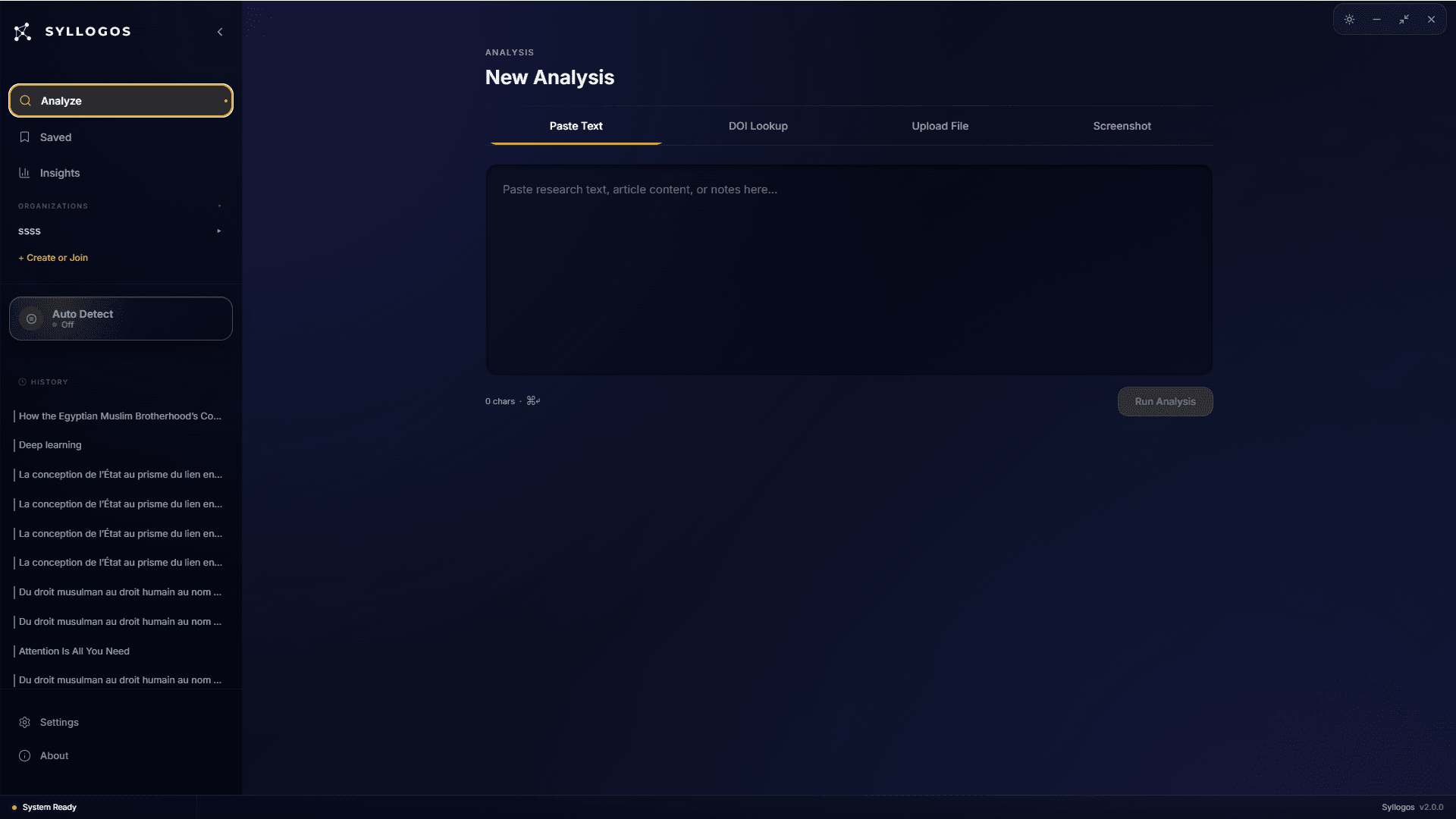
Open Syllogos over a paper. Paste text, enter a DOI, upload a file or capture your screen.
See how the framework turns a paper into an assessment you can question.
Research assessment in under three minutes.
4K product filmFilm 01Original overview · Includes earlier app screens
Sound on · Fullscreen available
Plans for individual researchers and teams. Paid plans are coming soon.
For getting started.
No credit card required
For regular research.
$180/year · save two months
For larger projects.
$499/year
For teams and labs.
From $22 per seat · pooled usage
Flexible allowances. Extra deep assessments: $0.45 each.
AI assessments can make mistakes.
Check the evidence and apply your own expertise.
About SyllogosAssess your own sources with CRAF 4.6 on Mac or Windows.
Try the browser demoChoose your platform
Windows: install from Microsoft Store. Mac: open the DMG and drag Syllogos into Applications.
Upload a paper, enter a DOI, capture a screen or paste text.
Run an assessment and review the evidence.